150-hour TEFL certification online for $35.
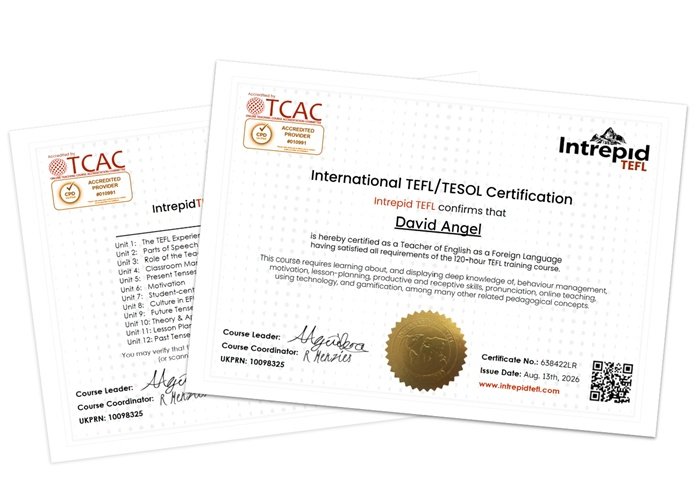
IntrepidTEFL’s 150-hour online TEFL course gives you the core 120-hour TEFL-TESOL foundation plus an added extension in teaching English to young learners and adults. Study online, complete structured quizzes and scenario tasks, and earn a digital TEFL certificate with QR-code verification included.
- ✓150-hour online TEFL course with QR verification
- ✓Includes young learner and adult teaching extension topics
- ✓Core TEFL grammar, planning, methodology, and skills training
- ✓Fully online, self-paced, beginner friendly, and affordable
Only $8 more than the 120-hour course: upgrade to 150 hours with extra young learner and adult teaching content.
A broader certificate for learners who want more than the basics.
The 150-hour TEFL course is designed for students who like the affordability of IntrepidTEFL’s 120-hour course but want additional training areas. The extra focus on TEYL and adult teaching helps you think more clearly about age, motivation, classroom routines, phonics, storytelling, materials, learner needs, and how different students learn English.
Core TEFL foundation
Build essential knowledge in grammar, lesson planning, methodology, classroom management, skills teaching, assessment, and online teaching.
Young learner extension
Learn how children differ from adult learners, how to use stories and games, how to manage routines, and how to teach early literacy through phonics and sight words.
Adult teaching focus
Explore adult learner motivation, needs analysis, classroom expectations, professional goals, confidence barriers, feedback, and practical management.
Video-supported learning
Use videos and structured tasks to connect teaching theory to practical examples, rather than relying only on passive reading.
QR-verifiable certificate
Complete the course and receive a digital TEFL certificate with QR-code verification, useful for presenting your training to schools and online platforms.
Flexible and self-paced
Study online with no fixed class time. You have up to six months from purchase to complete the course.
Upgrade your TEFL training with added young learner and adult teaching content.
$35 USD
The 150-hour course is ideal if you want a broader certificate than the 120-hour route while keeping your training affordable, online, and easy to access.
- ✓150-hour online TEFL course with QR certificate verification
- ✓Digital certificate with QR verification included
- ✓Core TEFL foundation plus TEYL and adult learner extension
- ✓Unit quizzes, course progression, midterm, and final assessment model
- ✓Technical and course-related support included
- ✓Six months of course access from your purchase date
The 120-hour course is still available for $27.
Choose the 120-hour course if you want the lowest-cost accredited TEFL route. Choose the 150-hour course if you want extra training hours and added young learner/adult teaching content for only a small price difference.
150-Hour TEFL Course Curriculum
The 150-hour route combines core TEFL training with an added extension in young learner and adult teaching. Search the units below or open each item to preview what learners can expect to study.
Overview: Introduces the TEFL profession and explores where, how, and with whom English teachers work. Learners examine online teaching, private lessons, language schools, institutional settings, and global English.
- Explain what TEFL involves across online, private, and institutional contexts.
- Compare learner profiles and identify common English-learning goals.
- Recognize how context shapes lesson design and teacher responsibilities.
- Reflect on possible TEFL pathways and personal teaching strengths.
Overview: Builds grammar confidence through the major word classes of English and focuses on how teachers can explain form, meaning, and use clearly.
- Identify the main parts of speech accurately.
- Explain grammar through contextual examples.
- Recognize common learner errors with form and word use.
- Design simple grammar practice activities.
Overview: Explores what teachers do before, during, and after lessons, including instruction, guidance, modeling, assessing, and professional classroom behavior.
- Describe the key roles a TEFL teacher performs.
- Build positive rapport while maintaining authority.
- Use clear instructions and appropriate teacher language.
- Reflect on how teacher behavior affects lesson outcomes.
Overview: Focuses on routines, classroom control, grouping, monitoring, instructions, and the practical habits that keep lessons organized and productive.
- Set up routines and expectations for smooth lessons.
- Use pair work, group work, and seating arrangements effectively.
- Respond to behavior issues calmly and appropriately.
- Monitor student work while maintaining class control.
Overview: Covers the present tense system and how to teach routines, current actions, ongoing states, examples, timelines, and controlled-to-freer practice.
- Differentiate the main present tense forms and uses.
- Teach present forms through context and timelines.
- Identify common learner errors.
- Create controlled and freer practice tasks.
Overview: Examines why learners engage, participate, and persist, with practical focus on confidence, goals, feedback, classroom climate, and motivation types.
- Distinguish between intrinsic and extrinsic motivation.
- Identify factors that raise or lower learner engagement.
- Use praise and feedback to increase confidence.
- Respond effectively to signs of low interest or withdrawal.
Overview: Shifts attention from teacher explanation to learner participation, interaction, autonomy, and meaningful language use.
- Reduce unnecessary teacher talking time.
- Increase learner interaction and decision-making.
- Use scaffolding to support independent task completion.
- Design pair and group work with clear language goals.
Overview: Explains how English expresses future meaning through plans, predictions, arrangements, schedules, spontaneous decisions, and context-based form choice.
- Differentiate common future forms and meanings.
- Teach future choices through situations and timelines.
- Identify frequent learner errors.
- Create speaking and writing tasks using future forms.
Overview: Introduces major approaches to language teaching and encourages informed flexibility rather than rigid dependence on one method.
- Differentiate between approach, method, and technique.
- Compare traditional and communicative teaching models.
- Balance fluency and accuracy work.
- Use interactive and task-based techniques appropriately.
Overview: Teaches how to build organized, purposeful, realistic lessons using aims, outcomes, staging, timing, interaction, checking, and feedback.
- Write clear lesson aims and measurable outcomes.
- Sequence activities in a teachable order.
- Use planning frameworks such as PPP and ESA.
- Adapt planning choices based on learner response.
Overview: Reviews core concepts from the first half of the course, including grammar, methodology, lesson planning, motivation, and classroom practice.
- Demonstrate understanding of foundational TEFL concepts.
- Apply grammar knowledge from early units.
- Recognize effective lesson structure and planning choices.
- Identify practical motivation and engagement strategies.
Overview: Covers past tense forms and teaching approaches for sequence, duration, completion, interrupted actions, earlier past actions, and narrative meaning.
- Differentiate the main past tense forms and uses.
- Teach past meaning through timelines and contextual examples.
- Use storytelling tasks to practice past language.
- Create past tense lessons from controlled to freer use.
Overview: Develops advanced grammar teaching through conditionals and reported speech, focusing on meaning, tense shifting, and student-friendly explanations.
- Teach conditionals clearly and accessibly.
- Explain real, possible, and hypothetical meanings.
- Present reported speech in manageable stages.
- Use concept-checking questions to confirm understanding.
Overview: Focuses on teaching vocabulary for communication, retention, and active use, including meaning, pronunciation, spelling, collocation, and word grouping.
- Select useful vocabulary based on learner level and goals.
- Teach meaning through visuals, context, and guided discovery.
- Highlight collocations and lexical relationships.
- Move learners from recognition to active vocabulary use.
Overview: Looks at speaking and writing as productive skills requiring support, task design, correction strategies, confidence building, and purposeful feedback.
- Design speaking tasks with real reasons to communicate.
- Teach writing through planning, drafting, and revising.
- Use correction strategies for speaking and writing.
- Assess productive work with useful criteria.
Overview: Treats pronunciation as a communication tool, covering individual sounds, word stress, sentence stress, rhythm, intonation, and connected speech.
- Teach pronunciation with intelligibility as the main goal.
- Model stress and intonation clearly.
- Use drilling and pronunciation activities purposefully.
- Integrate pronunciation into speaking and listening lessons.
Overview: Introduces reading and listening as active skills that require prediction, strategy use, comprehension support, and staged lesson design.
- Use pre-, while-, and post-stage lesson structure.
- Teach skimming, scanning, and predicting.
- Sequence tasks from gist to detail.
- Extend receptive work into speaking or writing follow-up.
Overview: Goes deeper into listening and reading sub-skills, text selection, learner processing, comprehension breakdowns, and scaffolded task design.
- Teach listening and reading for gist, detail, and inference.
- Select materials suited to level and lesson aims.
- Support comprehension of speed and connected speech.
- Diagnose common causes of receptive-skill difficulty.
Overview: Covers classroom and online tools including boards, visuals, handouts, realia, devices, and digital resources, with focus on purposeful use.
- Select equipment based on lesson aims and learner needs.
- Use boards, visuals, and handouts effectively.
- Integrate realia and props into communicative tasks.
- Adapt resources for low-tech and high-tech environments.
Overview: Explains how to assess learners fairly and meaningfully using informal and formal assessment, test types, rubrics, and feedback cycles.
- Differentiate formative and summative assessment.
- Use placement, progress, and achievement measures appropriately.
- Create tasks for reading, listening, speaking, and writing.
- Use assessment results to adjust future teaching.
Overview: Examines game-based learning and gamification as tools for participation, motivation, challenge, movement, collaboration, and language practice.
- Explain the difference between gamification and game-based learning.
- Design language games that remain purposeful.
- Use rewards and challenge without unhealthy pressure.
- Maintain control during high-energy tasks.
Overview: Introduces special learner groups including young learners, exam-preparation students, and adults with specific interests such as business English.
- Set up and manage an effective young learner classroom.
- Use engaging techniques such as TPR.
- Conduct needs analysis for different learner types.
- Understand common assessments such as IELTS.
Overview: Prepares teachers for online teaching through platform use, pacing, interaction, digital classroom management, and backup planning.
- Set up and manage an effective online teaching space.
- Use chat, breakout rooms, and screen sharing confidently.
- Adapt task flow and instructions for online delivery.
- Monitor understanding and participation remotely.
Overview: Takes learners through the world of ESL teaching abroad and online, including job searching, demos, applications, recruiters, and professional expectations.
- Identify common TEFL job types and destinations.
- Understand where to search for online and overseas roles.
- Prepare for demos, profiles, and applications.
- Approach job adverts with realistic expectations.
Overview: Introduces teaching English to young learners by looking at how children learn, how age affects attention and memory, and why young learner lessons require structure, movement, repetition, and emotional security.
- Define TEYL and identify typical young learner age ranges.
- Recognize how children’s cognitive, social, and emotional development affects lessons.
- Compare young learner needs with teenage and adult learner needs.
- Identify the teacher’s role as language model, routine builder, motivator, and classroom guide.
Overview: Explores practical young learner approaches such as play-based learning, TPR, songs, chants, routines, modeling, short task cycles, and meaningful repetition.
- Use TPR and movement to support understanding and memory.
- Build short, varied stages that match young learners’ attention spans.
- Use songs, chants, drilling, visuals, and routines purposefully.
- Balance fun with clear language learning outcomes.
Overview: Focuses on creating a child-friendly learning environment through routines, transitions, classroom layout, behavior expectations, safety, praise, and developmental awareness.
- Design routines that make lessons predictable and secure.
- Use transitions, signals, and classroom language effectively.
- Manage behavior with consistency, warmth, and clear expectations.
- Adapt activities to children’s developmental stage and confidence level.
Overview: Shows how stories and games can support listening, vocabulary, pronunciation, grammar patterns, confidence, and imagination when they are carefully staged and language-focused.
- Use stories to present and recycle language naturally.
- Plan pre-story, during-story, and post-story tasks.
- Choose games that support specific language aims.
- Manage competitive, cooperative, quiet, and movement-based games.
Overview: Looks at how to introduce grammar, vocabulary, pronunciation, and functional language to children while keeping motivation high and anxiety low.
- Teach vocabulary and grammar through examples, visuals, songs, and routines.
- Use repetition without making lessons feel mechanical.
- Support confidence through achievable tasks and positive feedback.
- Use rewards, goals, and progress markers carefully and fairly.
Overview: Covers how to select and adapt flashcards, worksheets, props, songs, videos, digital tools, and online activities so they support learning rather than distract from it.
- Select age-appropriate materials for clear language aims.
- Use flashcards, realia, puppets, visuals, and worksheets effectively.
- Integrate technology safely and purposefully.
- Adapt materials for online, low-resource, and mixed-level young learner classes.
Overview: Introduces additional contexts such as very young learners, pre-primary classes, mixed-ability groups, teens, online children’s lessons, parental expectations, and basic professional boundaries.
- Adapt lesson expectations for very young learners and pre-literate children.
- Recognize how teenagers differ from younger children.
- Support mixed-ability classes with flexible task design.
- Understand parent communication, professionalism, and basic safeguarding awareness.
Overview: Introduces early literacy support through sound-letter relationships, phonics routines, blending, segmenting, high-frequency words, sight words, and simple reading confidence.
- Explain the role of phonics in early English reading.
- Introduce sound-letter links through clear routines and examples.
- Use blending and segmenting activities at beginner level.
- Teach sight words and high-frequency words through recognition, repetition, and meaningful context.
Overview: Introduces the adult ESL classroom and explores how adult learners bring goals, experience, expectations, anxieties, time limits, and personal learning preferences to lessons.
- Recognize key characteristics of adult English learners.
- Compare adult learner motivation with young learner motivation.
- Use adults’ experiences and goals as lesson resources.
- Build respectful, practical, and relevant learning experiences.
Overview: Focuses on managing adult classes through needs analysis, goal setting, relevant materials, feedback, confidence support, professionalism, and practical lesson priorities.
- Conduct simple needs analysis for general, academic, online, or business English learners.
- Set realistic goals and select relevant lesson content.
- Manage adult participation, confidence, correction, and feedback sensitively.
- Adapt lessons for one-to-one, group, workplace, and online adult contexts.
Overview: The final assessment checks understanding across the core TEFL course and the added 150-hour extension topics, including young learner teaching, adult needs, methodology, systems, classroom practice, and lesson planning.
- Demonstrate understanding of core TEFL concepts.
- Apply teaching principles to young learner and adult learner scenarios.
- Recognize effective approaches to planning, management, motivation, and skills teaching.
- Consolidate knowledge needed for beginning online or overseas English teaching pathways.
Strong value reviews for IntrepidTEFL’s online TEFL training.
Students consistently highlight IntrepidTEFL’s value, fast online system, responsive support, and practical certificate access. These review excerpts help you compare the 120-hour and 150-hour options with confidence.
“Experience much better than their website!”
George described the course as clean, interactive, and worth more than the low price, highlighting the real-class video elements and included certificate download.
George Taylor United States · GoAbroad · August 19, 2026“Fast system with decent resources.”
Rob said he paid under $30, expected very little, but found the course actually tried to teach the process of teaching EFL and provided a working digital certificate.
Rob Bryant Canada · GoAbroad · August 13, 2026“Good value.”
Kathy called it a legitimate course that trains you how to teach English, especially noting the real-teacher assessment videos and online teaching confidence.
Kathy G United States · GoAbroad · July 18, 2026“Happy with my purchase.”
Stephen highlighted the LMS, interactivity, problem-solving elements, and support experience, saying the course did not feel cheap despite the price.
Stephen United Kingdom · GoOverseas · August 6, 2026“Very happy with the course and tutors.”
Tom praised the fast learning website, clear lessons, useful videos, review text, and practice quizzes, especially considering the course price.
Tom Austria · GoOverseas · June 2, 2026“Cheap, cheerful, but very good.”
Rosie found the course legitimate, fluid, and responsive, with helpful tutor replies and a certificate that worked for online teaching applications.
Rosie United States · GoOverseas · May 25, 2026Questions about the $35 150-hour online TEFL course.
Clear answers for learners comparing the 120-hour course and the 150-hour route with added young learner and adult teaching content.
The 150-hour TEFL course costs $35. That includes the online course and QR-verifiable digital certificate.
The 150-hour course includes the full TEFL foundation plus extra training in teaching English to young learners and adults. You’ll cover TEYL approaches, classroom setup, storytelling, games, motivation, materials, technology, phonics, sight words, adult learner needs, and adult classroom management.
Yes. Your digital TEFL certificate includes QR-code verification, so schools and employers can quickly check your certificate online.
The 150-hour course is the stronger choice if you want broader training and extra certificate hours. The 120-hour course is the budget option at $27, while the 150-hour course adds young learner and adult teaching content for $35.
You have six months from purchase to complete the course. You can study at your own pace, log in when it suits you, and work through the lessons and quizzes online.
Yes. If you want the lowest-cost option, choose the 120-hour course for $27. If you want the broader course with extra TEYL and adult teaching content, choose the 150-hour course for $35.
Earn a broader online TEFL certificate with added young learner and adult teaching content.
Choose the 150-hour TEFL course for $35 if you want the core TEFL foundation plus extra training in TEYL, phonics, sight words, adult learners, needs analysis, and practical classroom management.