ACCREDITED BY OTCAC

Cheap TEFL Course Certification $27

Affordable TEFL training with structured content, practical scenarios, videos of real ESL lessons, and a certificate with QR code verification included.

$27 one-time payment includes TEFL CERTIFICATE

24 course units, including online teaching

600+ assessment questions for embedded learning

10 scenario-based TEFL activities move past theory

14-Day Moneyback guarantee

Videos of real ESL teaching model the theory for you

Online TEFL is almost always the same...

What makes us different? We include these things that most others do not:

What varies is the quality of the course text, how it’s structured, its depth, the LMS platform quality, video support, memory-aids, and assessment quality. Then, of course, you have tutor support and the ability to apostille our certificates for work abroad or use them for online work digitally. 

Like almost all other online TEFL providers, we don’t offer practical teaching: that’s not going to happen for under $100, sorry. 

We offer quality content that’s organized and approachable for new teachers: high-quality but simple TEFL. Our content is supported by videos and concept-checking questions to help you learn. You’ll watch real-life ESL classroom teaching and apply theory to what you see. Assessments test recall and application, and you also need to apply theory to different scenarios. These things help you become a better, more confident teacher.

Our Accreditation:

UK Registered Learning Provider

Choose Intrepid TEFL'S $27 Online TEFL Certification

The IntrepidTEFL $27 120-Hour TEFL Course

Cheap TEFL Certification Accepted Worldwide – Digital Certificate Included $27

Ready to teach English abroad or online?

A cheap TEFL course doesn’t have to be a shallow TEFL course.

Many learners search for a cheap TEFL course because they need an affordable way to get TEFL certified. IntrepidTEFL is built for that purpose: a low-cost, online 120-hour TEFL course that still includes structured training, meaningful assessment, practical teaching scenarios, videos, and certificate verification.The course is fully online and automated, so you can move through the content at your own pace. It is designed for speed, clarity, and learning efficiency while still covering the essential topics new TEFL teachers need to understand.You don’t need previous teaching experience to begin.
Create an account at checkout to start learning 
once your secure payment is made.

Cheap TEFL accepted for teaching abroad

The best TEFL certification for digital nomads

Get TEFL certified for online English teaching

I finish the course in 8 days quickly with study number of hours less than 10 a day easy but sure I skip something but still I understand. Certificates are good looking and the code is working fine so I walking away a happy man sure. Is good, easy knowledge
Thabo Mokoena
GoOverseas.com


5.00/5.00 Rating

“Staff were amazing offering help with an error I had when I signed up putting in the wrong email.” – James

I recommend this course despite a couple of small quirks. A couple of videos had a bit of ghosty glitches with sound but overall the content was superb. If anything, I'd say there's perhaps more content than needed as there are over twenty units.
Roy Peters
GoOverseas.com


9.67/10.00 Rating

“I was bit worried first because low price but everything was very good.” – Jerry Liu

Fully online affordable TEFL course that’s accredited and includes QR-verification

Our 120‑hour TESOL course is just $27, making it one of the cheapest TEFL course certification programs available. 

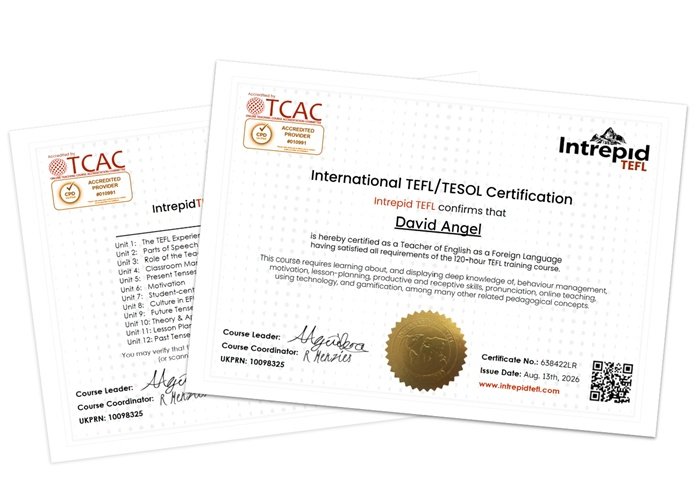
We include a single emailed PDF certificate with our $27 course (soon to be $29). This is a beautiful certificate with foil-seal image and QR code. If you need to verify your certificate, please head to our verification page.

You can order a second TEFL certificate that can be printed by you at home (no foil image), but it’s usually unnecessary, as most jobs only require the digital version. The course is accredited by OTCAC and CPD, and it’s created by experienced, passionate language teachers. 

With our quality but budget TEFL course certification, you’ll gain the knowledge and confidence to begin teaching online or abroad. Whether you’re a student, traveler, or looking for a career change, our 120‑hour TEFL–TESOL course prepares you to teach English online or abroad. Our certificates are accepted for online jobs and the majority in-person TEFL jobs abroad that you’d realistically be applying for with anything less than a Level-5 certification or CELTA.

Learn at your own pace and receive a digital certificate recognized by employers worldwide that can be verified online for validity and peace of mind.

Our TEFL course includes a dedicated unit on Teaching Online and scenario-based learning tasks

Why Should You Choose  IntrepidTEFL?
(Hint: it’s not just because we’re the cheapest accredited TEFL course.)

Fully Online

No essays. No assignments. No deadlines. No fixed start date. Fully flexible, automated, online learning.

Interactive

We use multiple choice questions and 'cognitive-scenario-learning' to force you to apply theory to teaching.

Video Learning

All lessons rely on expert-made text but we hand-picked videos to supplement learning and show real teaching in action.

Whether you’re dreaming of travel teaching…

Teaching English in a different country…

Or teaching English online from home…

Made by Professional, Experienced Language Teachers

IntrepidTEFL.com provides TESOL certification that’s both affordable and high‑quality. Our internationally dual-accredited online TEFL-TESOL course is built for aspiring teachers who want to teach English abroad or online. This industry‑standard 120‑hour TEFL course includes up‑to‑date training on teaching English online, integrating A.I., and using modern classroom techniques.

We’ve designed the content to be clean, engaging, and motivating – removing long, outdated essays and replacing them with interactive quizzes and practical scenario tasks that help reinforce your learning. Each module is supported with clear text and helpful video content, giving you a well‑rounded, practical online TESOL certification experience.

Explore TEFL Job Recruiters

Select a teaching destination or choose online roles. All links open in a new tab so you can explore opportunities and return to us anytime.

TEFL Overseas Or Home?

One of the biggest decisions you need to make is whether you want to leave the comfort of your home to teach, perhaps leaving everything behind for the beaches of Thailand or city buzz of Seoul, or whether you’ll set up your very own classroom from the comfort of home. If going abroad, use our country guide to help you.

TEFL-TESOL Country Guide

Popular TEFL Teaching Country Guide

Search 15+ popular TEFL destinations worldwide

Hourly Wage
Monthly Savings
Contract Length
TEFL Required
Native Speaker
Age Limit
Benefits & Highlights
Famous Places

Country not found

Try searching for another country or use the quick buttons above.

Searchable countries: South Korea, China, Spain, Japan, Thailand, Vietnam, Cambodia, UAE, Taiwan, Italy, Brazil, Colombia, Chile, Czech Republic, Turkey

We believe in being clear about what our course is – and what it is not.

Our 120-hour TEFL-TESOL course is not a CELTA, and no fully online, automated TEFL course can replace in-person practical teaching with observed classroom practice. The strongest teacher training normally includes real teaching practice, live tutor feedback, and guided lesson planning support from experienced trainers. Those options are more expensive for a reason, and for learners who need intensive practical training, they can be the better choice.

However, most online TEFL courses sit in a different category. Many rely mainly on written content and automated quizzes, whether they cost $27 or $200. A higher price does not automatically mean deeper training, better course design, or more practical learning.

That is where IntrepidTEFL is different.

We keep our course affordable because we believe accessible training should still be meaningful. Our 120-hour course is priced at $27, but it is not built as a bare-minimum certificate product. It includes structured lesson content, interactive learning tasks, regular assessments, scenario-based exercises, practical problem-solving activities, and video-based assessments using real ESL teaching footage. Video matters in online teacher training. It helps learners see teaching techniques, classroom interaction, instruction-giving, correction, and student engagement in action. Instead of only reading about teaching, learners are able to connect theory to real classroom situations.

The course includes:

  • 24 regular unit assessments
  • Scenario-based learning tasks
  • Practical problem-solving activities
  • Real ESL teaching video footage
  • 2 main video-based assessments
  • Clear, structured lesson content
  • A downloadable certificate after successful completion

Our pricing is low because we have chosen to keep the course accessible, not because we have removed the learning value. Once high-quality online course content is created, it can be delivered efficiently. We would rather pass that efficiency on to learners than charge more simply because the market allows it.

This course is designed for learners who want an affordable TEFL certificate, but still want a structured, thoughtful introduction to the core principles of ESL teaching. If you’re looking for an instant certificate or an empty course that can be rushed through in a few hours, IntrepidTEFL is probably not the right fit. We are affordable, but we are not a certificate vending machine.

Our goal is simple: practical, accessible TEFL training at an honest price.

Cheap TEFL Certification Accepted Worldwide – Our TEFL-TESOL Certificate Includes QR verification

Teach English in Ecuador

Teach English in Czech Republic

Teach English in Greece

Our 120-Hour TESOL Certification

The IntrepidTEFL 120‑hour TEFL‑TESOL course is fully verified and quality‑assured by OTCAC. This accreditation confirms that our course meets the strict standards set by OTCAC, giving schools and employers confidence in our affordable TESOL certification. Many TEFL providers use the terms TEFL and TESOL interchangeably because, over time, the distinctions have blurred – though they are technically different. Our online training covers both areas in depth, which is why your certificate includes both TEFL and TESOL. However, most schools don’t know the difference – but you will! Regardless, we offer cheap TESOL and cheap TEFL combined!

We offer one comprehensive and affordable TESOL course, delivered completely online for maximum flexibility. You can study from anywhere in the world and progress at your own pace. Each unit provides a complete learning experience with engaging quizzes to reinforce your understanding, along with clear, supportive video lessons. If you’re searching for cheap TEFL that still delivers high‑quality training and full certificate verification, the choice is easy: you’re in the right place with IntrepidTEFL.

120-Hour TEFL Course Curriculum

Overview: This opening unit introduces the reality of TEFL as a profession and explores where, how, and with whom English teachers work. It looks at different teaching environments, learner needs, and the practical choices teachers make in real classrooms. The unit also builds awareness of global English and what effective teaching looks like in different contexts.

  • Explain what TEFL involves across online, private, and institutional settings.
  • Compare common learner profiles and identify their English goals.
  • Recognize how teaching context shapes lesson design and teacher responsibilities.
  • Describe the role of English as an international language.
  • Develop an understanding of TEFL jobs across the globe
  • Reflect on personal strengths, preferences, and possible TEFL pathways.

Overview: This unit builds a strong grammar foundation through the major word classes of English. It focuses on how parts of speech function in real sentences and how teachers can explain them clearly. Practical teaching application is emphasized throughout.

  • Identify the main parts of speech in English accurately.
  • Explain how nouns, verbs, adjectives, adverbs, and pronouns work in context.
  • Recognize common grammar issues learners have with form and word use.
  • Teach grammar through examples instead of isolated rules only.
  • Use simple explanations that match learner level.
  • Design basic activities to practice grammar meaningfully.
  • Connect grammatical knowledge to real classroom teaching.

Overview: This unit explores what teachers actually do before, during, and after lessons. It covers professional responsibilities, classroom presence, and the different roles teachers shift between in order to support learning. The unit also emphasizes rapport, consistency, and teacher judgment.

  • Describe the key roles a TEFL teacher performs during lessons.
  • Differentiate between guiding, managing, modeling, and assessing roles.
  • Build positive relationships with learners while maintaining authority.
  • Use clear instructions and appropriate teacher language.
  • Understand professional expectations inside and outside the classroom.
  • Respond appropriately to learner needs during different lesson stages.
  • Reflect on how teacher behavior affects class atmosphere and outcomes.

Overview: This unit focuses on the practical skills teachers use to keep lessons organized, calm, and productive. It looks at routines, instructions, grouping, monitoring, and behavior support. Teachers learn how to create a classroom that is both structured and student-friendly.

  • Set up routines and expectations that support smooth lessons.
  • Give short, clear instructions that students can follow successfully.
  • Use pair work, group work, and seating arrangements effectively.
  • Balance friendliness with consistency and control.
  • Use voice, movement, and presence to manage attention.
  • Respond to behavior issues calmly and appropriately.
  • Monitor student work while maintaining overall class control.

Overview: This unit covers the present tense system and how to teach it clearly. It connects grammar form to meaning and typical usage, while also showing how to move from explanation to practice. Teachers learn how to present tense contrasts in ways learners can actually use.

  • Differentiate the main present tense forms and their uses.
  • Teach present forms through context, timelines, and examples.
  • Explain the difference between routines, current actions, and ongoing states.
  • Identify common learner errors with present tense usage.
  • Create controlled and freer practice tasks for present forms.
  • Use time expressions to clarify tense meaning.
  • Adapt present tense teaching for different learner levels.

Overview: This unit examines why learners engage, participate, and persist - or do not. It introduces major motivation types and shows how teacher behavior, task design, and classroom climate influence effort. The focus is on practical ways to build confidence and commitment.

  • Distinguish between intrinsic and extrinsic motivation.
  • Identify factors that raise or lower learner engagement.
  • Create a low-stress environment that supports participation.
  • Use praise and feedback in ways that increase confidence.
  • Set realistic goals that help learners notice progress.
  • Adapt motivation strategies for different ages and learner types.
  • Respond effectively to signs of low interest or withdrawal.

Overview: This unit shifts the focus from what the teacher says to what the learners do. It explores interaction, autonomy, and activity design that gives students more responsibility for using language. Teachers learn how to support without dominating.

  • Explain the principles of a student-centered classroom.
  • Reduce unnecessary teacher talking time during lessons.
  • Increase student speaking, interaction, and decision-making.
  • Use scaffolding to help learners complete tasks independently.
  • Design pair and group work with clear language goals.
  • Differentiate tasks for mixed-ability classes.
  • Encourage learner autonomy through purposeful task design.

Overview: This unit explores how culture affects language, communication, and classroom expectations. It helps teachers understand cultural difference without stereotyping and prepares them to teach in more inclusive, culturally aware ways. Language is treated as something used within social context, not apart from it.

  • Explain how culture influences communication and classroom behavior.
  • Recognize differences in expectations around interaction, hierarchy, and participation.
  • Teach language with attention to social appropriacy and context.
  • Avoid oversimplified assumptions about national or cultural groups.
  • Support learners in cross-cultural communication.
  • Reflect on personal bias and its effect on teaching decisions.
  • Create more inclusive and culturally responsive lessons.

Overview: This unit explains how English expresses future meaning through different forms and choices. It helps teachers present future language through situations learners can recognize, such as plans, predictions, arrangements, and schedules. The emphasis is on meaning before memorization.

  • Differentiate common future forms and their typical meanings.
  • Teach will, going to, and present forms used for future reference.
  • Use timelines and contexts to explain future choices clearly.
  • Help learners distinguish plans, spontaneous decisions, and scheduled events.
  • Identify frequent learner errors with future language.
  • Create speaking and writing tasks that require future forms.
  • Sequence future tense teaching from simple to more advanced uses.

Overview: This unit introduces major approaches to language teaching and why they matter in practice. It compares traditional and modern methods and shows how teachers can combine techniques rather than follow one model rigidly. The aim is to build informed flexibility.

  • Differentiate between approach, method, and technique.
  • Recognize key features of traditional and communicative teaching models.
  • Compare fluency-focused and accuracy-focused instruction.
  • Choose suitable approaches for different learners and contexts.
  • Use task-based and interactive techniques appropriately.
  • Reflect on the strengths and limits of major methodologies.
  • Combine approaches to create balanced lessons.

Overview: This unit teaches how to build lessons that are organized, purposeful, and realistic. It covers lesson stages, aims, timing, sequencing, and how to connect activities to outcomes. Teachers learn to plan with both structure and flexibility.

  • Write clear lesson aims and measurable outcomes.
  • Sequence activities in a logical and teachable order.
  • Use common planning frameworks such as PPP and ESA.
  • Match activities to learner level, age, and objectives.
  • Include interaction, checking, and feedback within a lesson plan.
  • Balance timing so lessons remain focused and manageable.
  • Adjust planning choices based on learner response and class needs.

Overview: This practice lesson gives trainees the chance to examine an authentic classroom plan, interact with each stage, and see how it supports the lesson aim.

  • Complete a digital lesson plan based on a clear objective.
  • Select suitable activities for specific language aims.
  • Prepare more confidently for real teaching delivery.

Overview: The midterm checks understanding of the core concepts from the first half of the course. It reviews grammar systems, methodology, lesson planning, motivation, and classroom practice. This assessment helps confirm progress before moving into more advanced topics.

  • Demonstrate understanding of foundational TEFL concepts.
  • Apply grammar knowledge from the early units.
  • Show awareness of key classroom management and teacher role principles.
  • Recognize effective lesson structure and planning choices.
  • Identify practical motivation and engagement strategies.
  • Reflect on areas of strength and improvement.

Overview: This unit covers the main past tense forms and how to teach them in clear, practical ways. It helps teachers explain sequence, duration, completion, and narrative meaning through examples and structured comparison. Communicative practice and error awareness are both emphasized.

  • Differentiate the main past tense forms and their uses.
  • Teach past meaning through timelines and contextual examples.
  • Help learners express completed, interrupted, and earlier past actions.
  • Identify common student errors with past tense forms.
  • Use storytelling and narrative tasks to practice past language.
  • Teach reported sequence and time relationships more clearly.
  • Create past tense lessons that move from controlled to freer use.

Overview: This unit develops more advanced grammar teaching through conditionals and reported speech. It focuses on helping learners understand real versus hypothetical meaning, tense shifting, and sentence transformation. Teachers also practice simplifying complex language points for students.

  • Teach zero, first, second, third, and mixed conditionals clearly.
  • Explain real, possible, and hypothetical meanings accessibly.
  • Present reported speech and backshifting in manageable stages.
  • Identify sentence patterns that often confuse learners.
  • Use concept-checking questions to confirm understanding.
  • Create communicative practice tasks using target grammar.
  • Diagnose and correct common learner errors systematically.

Overview: This unit focuses on teaching vocabulary in ways that support communication, retention, and active use. It explores meaning, pronunciation, spelling, collocation, and word grouping. The unit is highly practical and centered on classroom activities.

  • Select useful vocabulary based on learner level and goals.
  • Teach word meaning through visuals, context, and guided discovery.
  • Model pronunciation, stress, and spelling of new items.
  • Highlight collocations and lexical relationships.
  • Use flashcards, games, and categorization tasks effectively.
  • Move learners from recognition to active vocabulary use.
  • Design vocabulary practice that supports speaking and writing.

Overview: This unit looks at speaking and writing as productive language skills that need support, structure, and purposeful feedback. It covers task design, scaffolding, correction, and confidence building. Teachers learn how to help learners produce language more accurately and fluently over time.

  • Design speaking tasks that create real reasons to communicate.
  • Sequence productive work from guided practice to freer output.
  • Support reluctant speakers with appropriate scaffolding.
  • Teach writing through planning, drafting, and revising stages.
  • Use different correction strategies for speaking and writing tasks.
  • Provide feedback that improves performance without discouraging learners.
  • Assess productive work using clear and useful criteria.

Overview: This unit focuses on pronunciation as a tool for clear communication rather than perfection. It covers sounds, stress, rhythm, intonation, and connected speech. Teachers learn how to integrate pronunciation into everyday lessons in practical, confidence-building ways.

  • Teach pronunciation with intelligibility as the main goal.
  • Differentiate between individual sounds and broader speech features.
  • Model word stress and sentence stress clearly.
  • Introduce intonation patterns that affect meaning.
  • Use drilling and pronunciation activities purposefully.
  • Identify learner errors that most affect communication.
  • Integrate pronunciation practice into speaking and listening lessons.

Overview: This unit introduces reading and listening as active skills that require strategy, prediction, and processing. It shows teachers how to plan lessons that help learners understand texts more effectively. The focus is on teaching comprehension, not just checking it.

  • Differentiate receptive skills from productive skills.
  • Use pre-, while-, and post-stage lesson structure effectively.
  • Activate background knowledge before reading or listening tasks.
  • Teach strategies such as skimming, scanning, and predicting.
  • Sequence tasks from general understanding to detailed comprehension.
  • Support learners with appropriately scaffolded texts.
  • Extend receptive work into speaking or writing follow-up tasks.

Overview: This unit goes deeper into listening and reading sub-skills, text selection, and comprehension support. It highlights how learners process information and where breakdowns often happen. Teachers learn to choose materials and tasks more precisely.

  • Teach listening and reading for gist, detail, and inference.
  • Differentiate intensive and extensive receptive work.
  • Select materials suited to learner level and lesson aims.
  • Support comprehension of spoken features such as speed and connected speech.
  • Use authentic and adapted texts appropriately.
  • Design task sequences that build confidence and understanding.
  • Diagnose common causes of reading or listening difficulty.

Overview: This unit explains how to assess learners fairly and meaningfully. It covers both formal and informal assessment, different test types, and the link between assessment and teaching decisions. Teachers learn how to evaluate progress without losing sight of real communication.

  • Differentiate formative and summative assessment clearly.
  • Use placement, progress, and achievement measures appropriately.
  • Create tasks that assess reading, listening, speaking, and writing.
  • Apply validity and reliability principles in basic test design.
  • Use rubrics to make speaking and writing assessment clearer.
  • Give feedback that helps learners improve.
  • Use assessment results to adjust future teaching.

Overview: This unit focuses on the tools and resources teachers use to support learning in both physical and digital classrooms. It covers boards, visuals, worksheets, realia, devices, and online tools. The main goal is to use equipment with purpose rather than for decoration.

  • Select classroom equipment based on lesson aims and learner needs.
  • Use boards, visuals, and handouts clearly and effectively.
  • Integrate realia and simple props into communicative tasks.
  • Use digital tools to support interaction and comprehension.
  • Manage materials in ways that reduce confusion and wasted time.
  • Adapt resources for low-tech and high-tech teaching environments.
  • Evaluate whether equipment choices genuinely improve learning.

Overview: This unit extends motivation work by looking at game-based learning and gamification. It shows how points, goals, challenge, movement, and collaboration can increase engagement when used well. The focus stays on learning outcomes, not entertainment alone.

  • Explain the difference between gamification and game-based learning.
  • Use game elements to support participation and progress.
  • Design language activities that are fun but still purposeful.
  • Use rewards and challenge without creating unhealthy pressure.
  • Promote cooperation as well as friendly competition.
  • Match games to age, level, and lesson aim.
  • Maintain strong classroom control during high-energy tasks.

Overview: This unit prepares teachers for online teaching by focusing on platform use, interaction, pacing, and digital classroom management. It explains how to adapt teaching techniques for virtual environments while keeping lessons engaging and communicative. Practical delivery is central throughout.

  • Set up and manage an effective online teaching space.
  • Use features such as chat, breakout rooms, and screen sharing confidently.
  • Adapt instructions and task flow for online delivery.
  • Keep learners engaged through varied digital interaction patterns.
  • Teach the four skills effectively in an online format.
  • Monitor understanding and participation remotely.
  • Prepare backup plans for common technical problems.

Overview: This unit explores how AI can support TEFL teachers in planning, resource creation, differentiation, and admin tasks while still keeping the teacher in control. It focuses on practical uses such as generating lesson ideas, adapting texts, creating worksheets, building unit plans, and personalizing language for level and age. The unit also stresses accuracy checking, ethical use, and using AI to save time without lowering teaching quality.

  • Use AI tools to generate lesson plans, warmers, and activity ideas more efficiently.
  • Create worksheets, discussion prompts, quizzes, and classroom resources with AI support.
  • Adapt texts, instructions, and target language for different levels and learner ages.
  • Use AI to build unit plans, sequence language aims, and recycle vocabulary over time.
  • Generate examples, dialogues, and model answers for grammar and skills lessons.
  • Check AI output critically for accuracy, level appropriacy, and bias before using it.
  • Apply AI responsibly to save planning time while preserving sound pedagogy and teacher judgment.

Overview: This bonus unit focuses on teaching children and how young learners differ from teens and adults in attention, cognition, energy, and emotional needs. It introduces developmentally appropriate teaching ideas, including movement, repetition, TPR, visuals, songs, routines, and shorter task cycles. The unit helps teachers design lessons that are lively, structured, and age-appropriate rather than simply simplified adult lessons.

  • Explain how young learners differ from older students in development and learning style.
  • Apply basic developmental ideas, including age-appropriate expectations and task design.
  • Use TPR, gesture, songs, chants, and movement to support comprehension and memory.
  • Plan shorter, varied activities that match children’s attention spans and energy levels.
  • Create routines, repetition, and visual support that help children feel secure and successful.
  • Manage behavior positively while keeping lessons active and engaging.
  • Design fun, purposeful lessons that teach language through play, action, and interaction.

Overview: The final exam evaluates understanding across the course as a whole, including grammar systems, methodology, planning, skills teaching, classroom practice, and specialist areas. It serves as the final checkpoint before course completion. The assessment confirms readiness to apply TEFL knowledge in practical teaching situations.

  • Demonstrate understanding of core TEFL concepts across the full course.
  • Apply language systems knowledge to teaching scenarios.
  • Show confidence with planning, methodology, and classroom practice principles.
  • Recognize effective approaches to skills teaching and assessment.
  • Reflect on progress across the course and remaining growth areas.
  • Consolidate knowledge needed for professional teaching readiness.

OTCAC Accreditation

IntrepidTEFL's 120-hour online TEFL course is accredited by OTCAC. For almost a decade, OTCAC has operated with strict benchmarks to accredit online courses. OTCAC: 20250311N

CPD Accreditation

IntrepidTEFL is an approved provider according to CPD-verified's objective standards. This is a fairly new accreditation company but we also have UKRLP status.

120-Hour online tefl course only $27

We are TEFL experts who want to share our knowledge with new teachers. Get TEFL certified and pocket the difference.